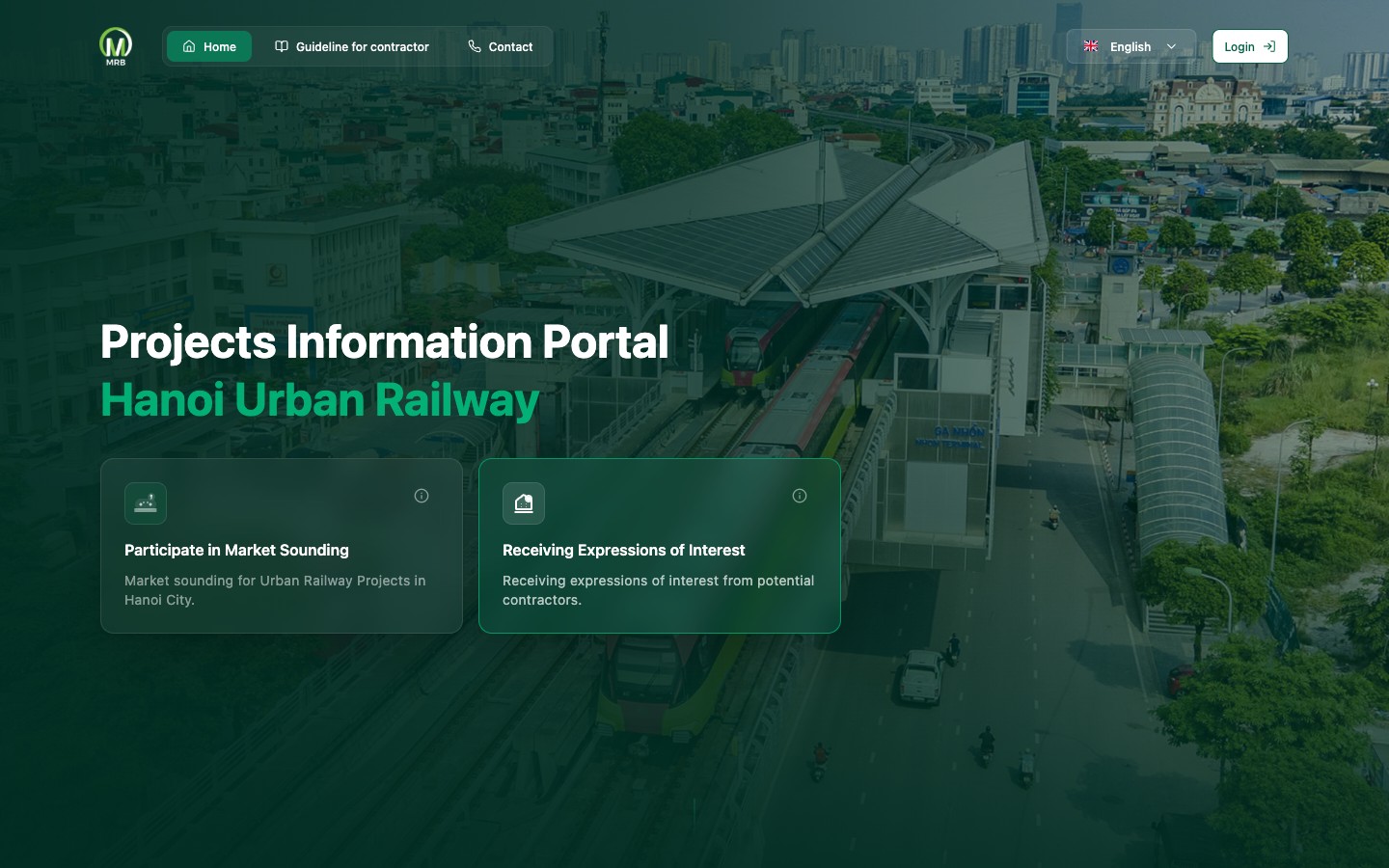
The Hanoi Metropolitan Railway Management Board (MRB) engaged TechTack to design and build the official Projects Information Portal for Hanoi Urban Railway — a secure, bilingual platform that takes contractor market sounding and expressions of interest online, aligned to the international OC4IDS open-contracting standard and Vietnam's 2025 contractor-selection law.
Hanoi is building one of Southeast Asia's most ambitious urban-rail networks — a programme measured in billions of dollars and watched by contractors across the world. The question MRB brought to us was deceptively simple: how do you open that programme to the market transparently, bilingually, and inside a brand-new legal framework — without it ever being doubted?
In public infrastructure, transparency isn't a feature you add at the end. It's the foundation everything else is built on.
So we didn't approach this as a form on a website. We approached it as a public trust platform — one built to international open-contracting standards from the first line of code.
The challenge
To select contractors for its urban-rail packages — including through direct appointment under Resolution 188/2025/QH15 and market consultation under Decree 214/2025/ND-CP — MRB needed to reach the market and capture contractor capabilities in the open.
That created three pressures at once. The law was brand new, so the platform had to mirror rules that had only just come into force. The audience was international, so Vietnamese and English both had to be first-class. And because this is public procurement, every interaction had to be secure and auditable by design — not a marketing microsite, but infrastructure the public could trust.
Two contractor engagement flows
From that foundation, the portal puts two regulated processes online — each anchored to its legal basis, each captured as structured, disclosable data.
Participate in Market Sounding
Lets the authority consult the market on upcoming urban-rail packages before procurement — gathering input that shapes requirement documents, in the open.
Receiving Expressions of Interest
Lets potential contractors formally register interest and submit their capability and experience for transparent review and shortlisting.
How we delivered it
A regulated, public-sector build, run end to end: from modelling the procurement data to standing it up as a production system the authority can operate with confidence.
- 1
Modelled the procurement data to OC4IDS
Before designing a single screen, we mapped each engagement flow to the OC4IDS schema — project identification, contracting process, and contractor submissions as structured, disclosable records. Transparency became a property of the data model, not a label on a page. PostgreSQL holds it as the single source of truth.
- 2
Architected security and consent into the core
Authenticated access, controlled submission workflows, least-privilege roles, and an explicit personal-data consent step aligned with Vietnam's data-protection rules — designed in from the start so sensitive contractor information is handled correctly at every step, not patched on after launch.
- 3
Built bilingual content as a first-class system
Vietnamese and English run as parallel, equally authoritative content rather than machine-translated bolt-ons — so a local reviewer and an international contractor work from the exact same source of truth, with nothing lost between languages.
- 4
Anchored every flow to its legal basis
Market sounding and expressions of interest each map directly to Resolution 188/2025/QH15 and Decree 214/2025/ND-CP, so the platform enforces the precise procurement rules it serves and stays auditable against the law as written.
- 5
Engineered it to run in production
Containerised with Docker and orchestrated on Kubernetes over AWS, with Grafana for observability and GitHub-based CI/CD for safe, reviewable releases — a stack chosen so the portal stays available, monitored, and maintainable long after go-live.
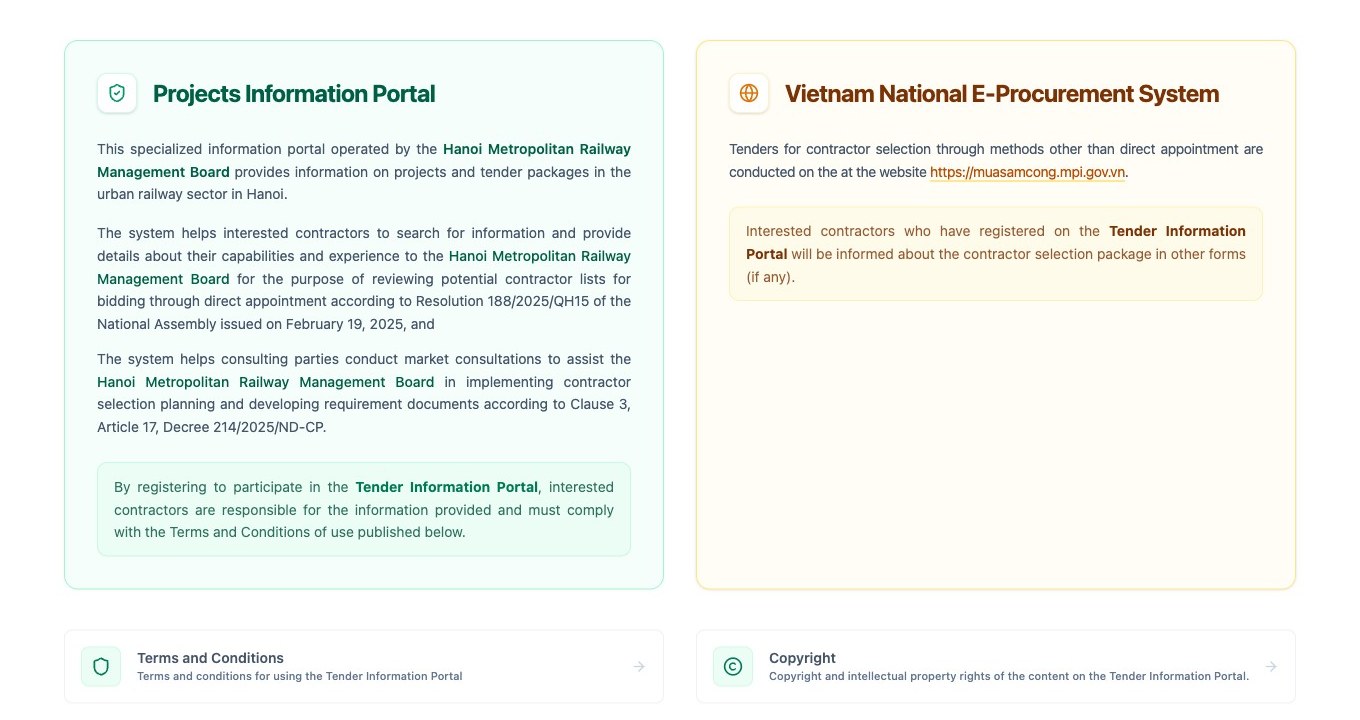
The result
MRB now runs an official, live portal — tenders.mrb.hanoi.vn — that brings market sounding and expressions of interest online for Hanoi's urban-rail programme. Contractors, including international ones, engage through a secure, bilingual, open-contracting-aligned channel carrying the authority's official identity.
A legal mandate became a working public platform — and a transparency credential the authority can point to. That's the difference between digitising a process and building public trust.
Curious what a build like this costs? See our guide on how much custom software costs in Vietnam, or tell us what you're building.
Technology stack
A representative view of the tooling behind a secure, bilingual government platform.
 PostgreSQL
  Docker
  Kubernetes
  AWS
AWS  Grafana
  GitHub
 Frequently Asked Questions
What is the MRB Tender Information Portal?
It's the official online portal of the Hanoi Metropolitan Railway Management Board, where the authority conducts market sounding and receives expressions of interest from contractors for Hanoi's urban-rail projects. It runs bilingually in Vietnamese and English at tenders.mrb.hanoi.vn.
What legal framework does the portal operate under?
Its contractor-selection flows are grounded in Resolution 188/2025/QH15 (issued by the National Assembly on 19 February 2025), which enables direct appointment for urban-rail projects, and market consultation under Decree 214/2025/ND-CP.
What is OC4IDS and why does it matter for this portal?
OC4IDS — Open Contracting for Infrastructure Data Standards — is the international standard for disclosing public infrastructure projects across their full lifecycle, combining the Open Contracting Data Standard with the CoST Infrastructure Data Standard. Aligning the MRB portal to it means procurement information is structured, comparable, and ready for public scrutiny, in line with how transparency bodies and international contractors expect open contracting to work.
Can TechTack build secure government and public-sector portals?
Yes. The MRB portal — and a similar tender portal for HCMC Urban Railway (MAUR) — are live examples of TechTack delivering secure, bilingual, compliance-grounded systems for public authorities, with authentication and data protection handled by design.
How long does a portal like this take to build?
It depends on scope, integrations, and compliance requirements. Government portals with secure submissions and bilingual content sit at the more involved end. Share your requirements and we'll give you a clear estimate on scope, timeline, and cost.