Introduction: Why CEOs Must Rethink Transformation in 2026
Over the past decade, digital transformation has become a priority for most organizations. However, despite heavy investments in new technologies, many companies still struggle to achieve meaningful results.
The core issue is not the lack of tools - it is the lack of strategic transformation at the business level.
In 2026, this gap becomes increasingly visible. Markets are evolving rapidly, customer expectations are continuously rising, and digital-native competitors are redefining entire industries. In this context, incremental improvements are no longer sufficient.
What organizations need today is digital business transformation - a deeper shift that goes beyond technology and focuses on rethinking how the business itself operates and creates value.
👉 For a broader overview, you can explore our pillar guide on digital transformation for enterprises in 2026.
What is Digital Business Transformation?
A Shift Beyond Technology Adoption
Digital business transformation is often misunderstood as simply adopting new technologies. In reality, it represents a fundamental shift in how an organization defines its value proposition and operates in a digital-first environment.
Rather than focusing on tools, this approach challenges core assumptions: how products are delivered, how customers are engaged, and how revenue is generated. Technology acts as an enabler, but the transformation itself is strategic.
For example, a company that digitizes its internal workflows may improve efficiency. However, a company that redesigns its offerings—such as moving from one-time sales to subscription-based services - creates entirely new value streams.
Redefining Value Creation in a Digital Economy
At its core, digital business transformation is about redefining how value is created and delivered. This often involves combining digital capabilities with new business models to meet changing customer expectations.
Organizations that succeed in this transformation are those that can continuously adapt. They do not treat transformation as a one-time initiative, but as an ongoing process of evolution.
This mindset shift is what separates companies that simply adopt technology from those that truly transform.
Digital Transformation vs Digital Business Transformation
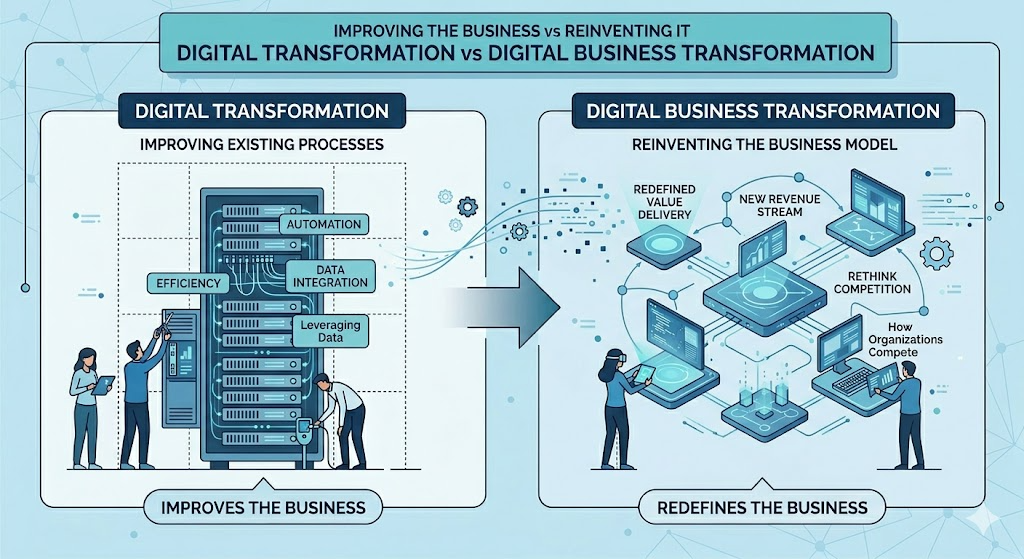
Improving the Business vs Reinventing It
Although the two terms are often used interchangeably, the difference between them is critical.
Digital transformation focuses on improving existing processes. It helps organizations become more efficient by automating tasks, integrating systems, and leveraging data. However, these improvements typically stay within the boundaries of the current business model.
Digital business transformation, on the other hand, focuses on reinventing the business itself. It challenges organizations to rethink how they compete, how they deliver value, and how they generate revenue.
In short: one improves the business, the other redefines it.
Why the Difference Matters for CEOs
For executives, misunderstanding this distinction often leads to misaligned investments. Companies may spend heavily on technology without achieving meaningful strategic outcomes.
By focusing on digital business transformation, CEOs can ensure that technology investments are directly tied to long-term growth and competitive advantage, rather than short-term efficiency gains.
The Core Pillars of Digital Business Transformation
Business Model Innovation
A successful transformation begins with rethinking the business model. Organizations must evaluate whether their current approach to generating revenue is still relevant in a digital-first market.
Many companies are shifting toward subscription models, platform-based ecosystems, or data-driven services. These models not only create new revenue streams but also strengthen customer relationships over time.
Without business model innovation, even the best technology delivers limited impact.
Customer-Centric Experience Design
Customer expectations have fundamentally changed. Today’s customers demand seamless, personalized experiences across every touchpoint.
Digital business transformation requires organizations to rethink the entire customer journey - identifying friction points, integrating digital channels, and delivering consistent interactions.
The goal is not just to meet expectations, but to anticipate them before they arise.
Data and Intelligence as a Competitive Advantage
Data is no longer just a byproduct of operations - it is a strategic asset. Organizations that can effectively collect, analyze, and act on data gain a significant competitive advantage.
Instead of relying on assumptions, businesses can use real-time insights to optimize performance, predict trends, and uncover new opportunities.
In a digital economy, the companies that win are those that learn faster.
Agile Operating Model
Traditional organizational structures are often too rigid to support transformation. Decision-making can be slow, and collaboration across departments may be limited.
An agile operating model addresses these challenges by promoting flexibility, cross-functional teamwork, and faster execution cycles.
This allows organizations to respond quickly to change—and continuously improve.
Technology as an Enabler
While technology is not the starting point, it remains a critical enabler of transformation. Cloud platforms, artificial intelligence, and integrated systems provide the infrastructure needed to scale and innovate.
The key is not adopting more technology—it is aligning technology with strategy.
The CEO’s Role in Driving Transformation
Setting a Clear Strategic Vision
Digital business transformation requires strong leadership and a clearly defined vision. CEOs must articulate what transformation means for their organization and how it supports long-term goals.
A clear vision ensures that every initiative contributes to a shared direction.
Aligning the Organization
One of the biggest barriers to transformation is organizational misalignment. Different departments may pursue conflicting priorities, leading to fragmented execution.
CEOs must ensure alignment across teams—breaking down silos and fostering collaboration.
Without alignment, even the best strategy will fail in execution.
Driving Cultural Change
Technology can be implemented relatively quickly—but culture takes time to change. Employees must adapt to new ways of working, which can create resistance.
Leaders play a crucial role in building a culture that embraces experimentation, continuous learning, and adaptability.
Transformation succeeds when people—not just systems—evolve.
What Should a CEO's Digital Transformation Leadership Strategy Include in 2026?
A CEO leadership strategy for digital transformation in 2026 needs five elements: (1) a vision tied to a measurable business outcome, (2) an aligned executive team with clear ownership, (3) a funded 12–18 month roadmap sequenced by impact, (4) an explicit position on AI adoption, and (5) visible cultural sponsorship from the top. Transformations led personally by the CEO are consistently more likely to deliver sustained results than those delegated entirely to IT.
The 5-Point CEO Checklist
- Anchor the vision in one business outcome. Not “become digital” but “grow recurring revenue to 30% of total” or “cut order-to-cash time in half”. Every initiative must trace back to that number.
- Assign executive ownership, not committee ownership. Each transformation stream needs one accountable leader with budget authority — shared ownership is how initiatives stall.
- Sequence a 12–18 month roadmap by impact. Start with one high-visibility win in the first 90 days to build momentum, then scale what works.
- Take an explicit AI position. In 2026, AI is the dividing line of transformation strategy: decide where AI agents and automation create advantage in your value chain, and where human judgment stays central.
- Sponsor the culture change personally. Employees mirror what leadership measures and celebrates. If the CEO reviews transformation metrics monthly and publicly, the organization follows.
Use this checklist as the operating rhythm: vision → ownership → roadmap → AI position → culture, reviewed quarterly.
A Strategic Framework for Digital Business Transformation
Defining Business Objectives First
A common mistake is starting with technology rather than strategy. Organizations should begin by defining clear business objectives, such as improving customer experience or entering new markets.
This ensures that transformation efforts remain focused and outcome-driven.
Identifying High-Impact Opportunities
Once objectives are clear, organizations must identify where transformation will create the most value. This involves analyzing customer needs, market dynamics, and internal capabilities.
Prioritization is key—not everything needs to be transformed at once.
Designing and Scaling the Transformation
After identifying opportunities, organizations can design their future state, including new business models and operating structures.
Execution should be iterative: start small, measure impact, and scale what works.
👉 To see how this works in practice, you can explore full digital transformation case studies across various industries.
Transformation is not a single leap - it is a series of deliberate steps.
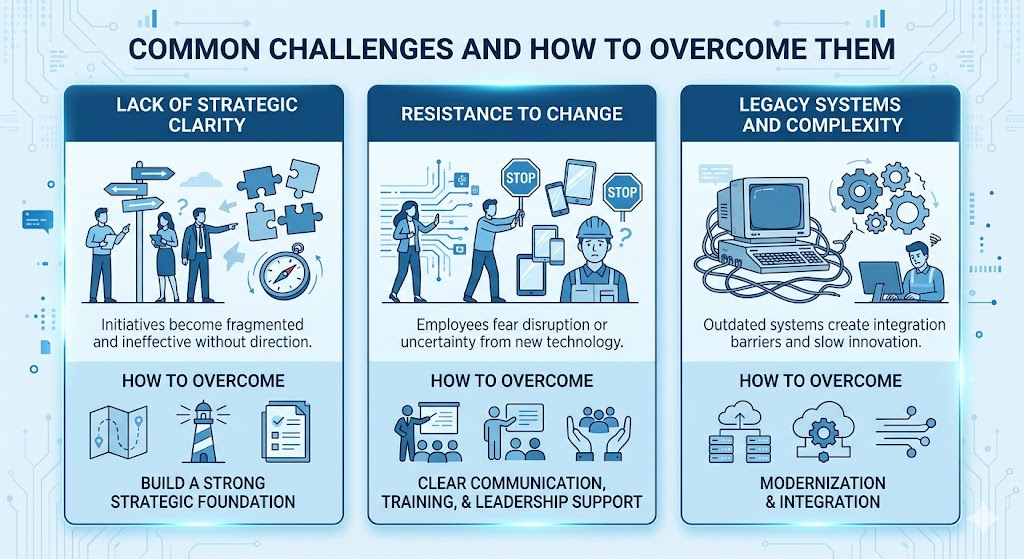
Common Challenges and How to Overcome Them
Lack of Strategic Clarity
Many organizations struggle because they lack a clear transformation strategy. Without direction, initiatives become fragmented and ineffective.
👉 How to overcome this: A strong strategic foundation is essential.
Resistance to Change
Employees may resist transformation due to uncertainty or fear of disruption.
👉 How to overcome this: Clear communication, training, and leadership support are critical to overcoming this challenge.
Legacy Systems and Complexity
Outdated systems often create significant barriers to transformation, making integration difficult and slowing innovation.
👉 How to overcome this: A phased modernization approach is often the most effective path forward.
👉 For a deeper look at how smaller organizations navigate these obstacles, you can explore the challenges of digital business transformation for SMEs corporations.
Conclusion: Moving Beyond Transformation
Digital business transformation is not just about adapting to change—it is about leading it.
For CEOs, the challenge is to move beyond incremental improvements and rethink how the business operates in a digital-first world. This requires aligning strategy, technology, and culture into a cohesive transformation effort.
👉 If you are starting this journey, begin with our complete guide to digital transformation for enterprises in 2026.
The organizations that succeed are not the ones that change the fastest - but the ones that change in the right direction.
Related at TechTack
Frequently Asked Questions
What is digital business transformation?
It is the strategic redesign of how a company operates and delivers value using digital technology, going beyond tools to change processes, culture, and business models.
How is digital business transformation different from digital transformation?
Digital transformation often focuses on adopting technology; digital business transformation centers on changing the business model and the outcomes that technology enables.
What role does the CEO play in digital business transformation?
The CEO sets the vision, aligns leadership, funds the change, and drives the culture shift. Transformation stalls without active executive ownership.
What should a CEO's digital transformation leadership strategy include in 2026?
Five elements: a vision tied to one measurable business outcome, named executive owners per stream, a 12–18 month impact-sequenced roadmap, an explicit AI adoption position, and personal cultural sponsorship — reviewed on a quarterly rhythm.